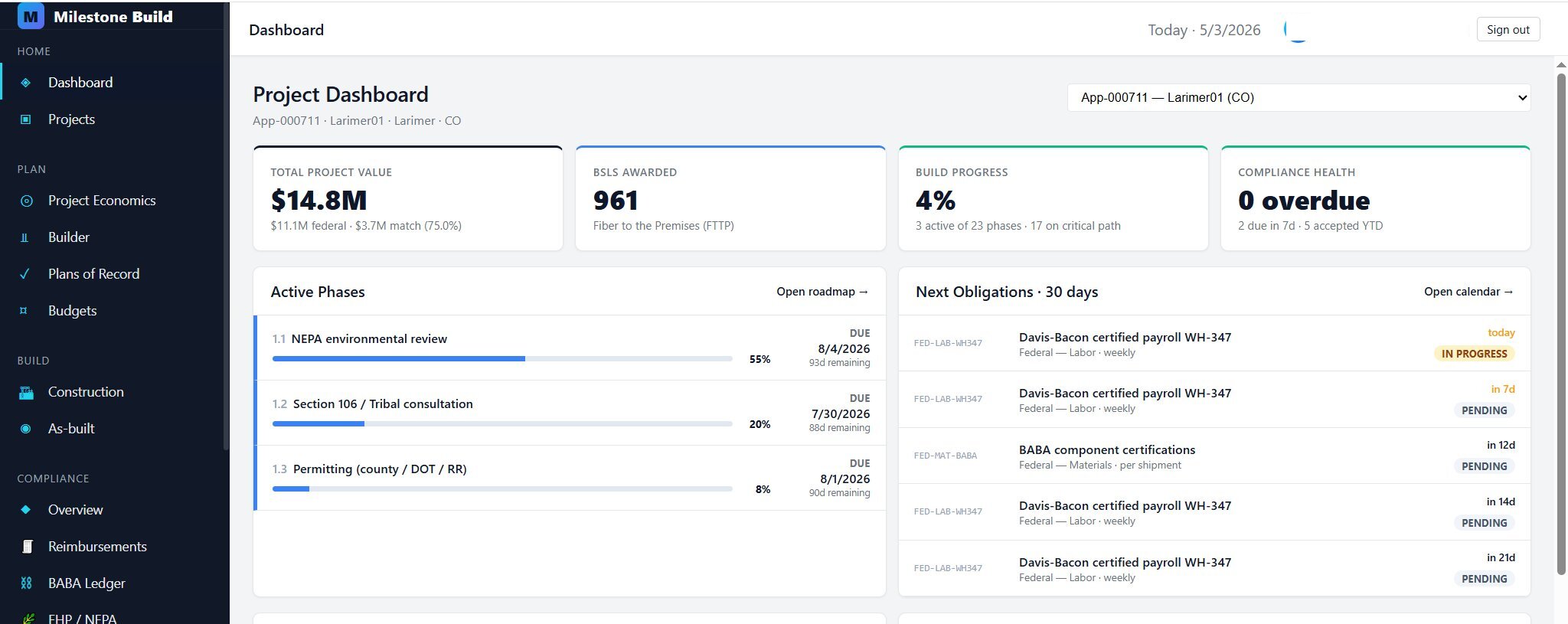
A real project dashboard. Total project value, BSLs awarded, build progress, compliance health — at a glance, per project, across the portfolio.
Plan the network, engineer the routes, run procurement, capture the evidence, and generate the draw packet — across one award or fifty. Build is the platform that turns BEAD's clawback risk into a one-click audit binder.
A real project dashboard. Total project value, BSLs awarded, build progress, compliance health — at a glance, per project, across the portfolio.
An ISP taking BEAD money has to satisfy 2 CFR Part 200 procurement rules, BABA Buy America for every covered material, Davis-Bacon weekly certified payrolls, NEPA and Section 106 environmental review, FCC performance measure tests, the Low-Cost Service Plan commitment, semi-annual SAR 2.0 reporting, and roughly 75 other line items.
Today most ISPs manage this in spreadsheets, email threads, and shared drives. The clawback risk is real — if you can't produce the audit trail, federal money gets recovered.
The cost of getting this wrong: A single failed audit can trigger a partial or full clawback of grant funds, plus exclusion from future federal programs. The records you don't keep today are the records the auditor will ask for in three years.
BEAD pays for the awarded BSLs. The real money is in the non-BEAD passings nearby — homes you'd be insane not to also serve once your fiber's already in the ground. Build does the bolt-on math.
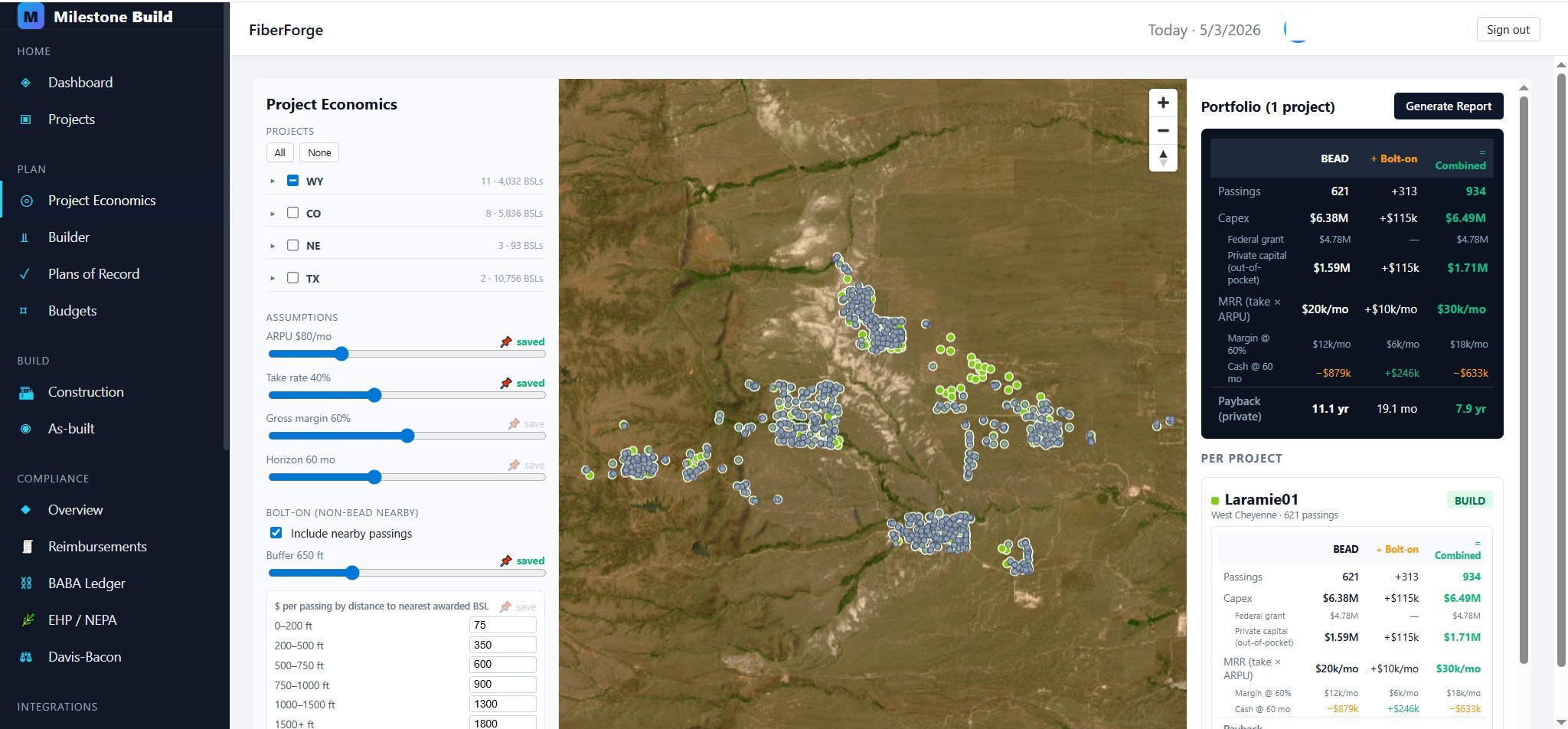
ARPU, take rate, gross margin, horizon, distance buffer. The model rebuilds in real time on the actual passings on the map — no separate spreadsheet, no stale assumptions.
621 BEAD passings. 313 nearby private. 934 combined. Capex, MRR, margin, and payback shown for each cohort independently — so you can see exactly where the federal grant ends and the operator return begins.
Multi-project, multi-state portfolios summed automatically. Generate Report exports a clean PDF for the board or the lender.
Build flags it before the draw request goes out. Auto-clusters BSLs, routes fiber on real roads, prices it at your state's actual BEAD bid rates, and runs the variance against your Bid-on-the-Bid commitment in real time.
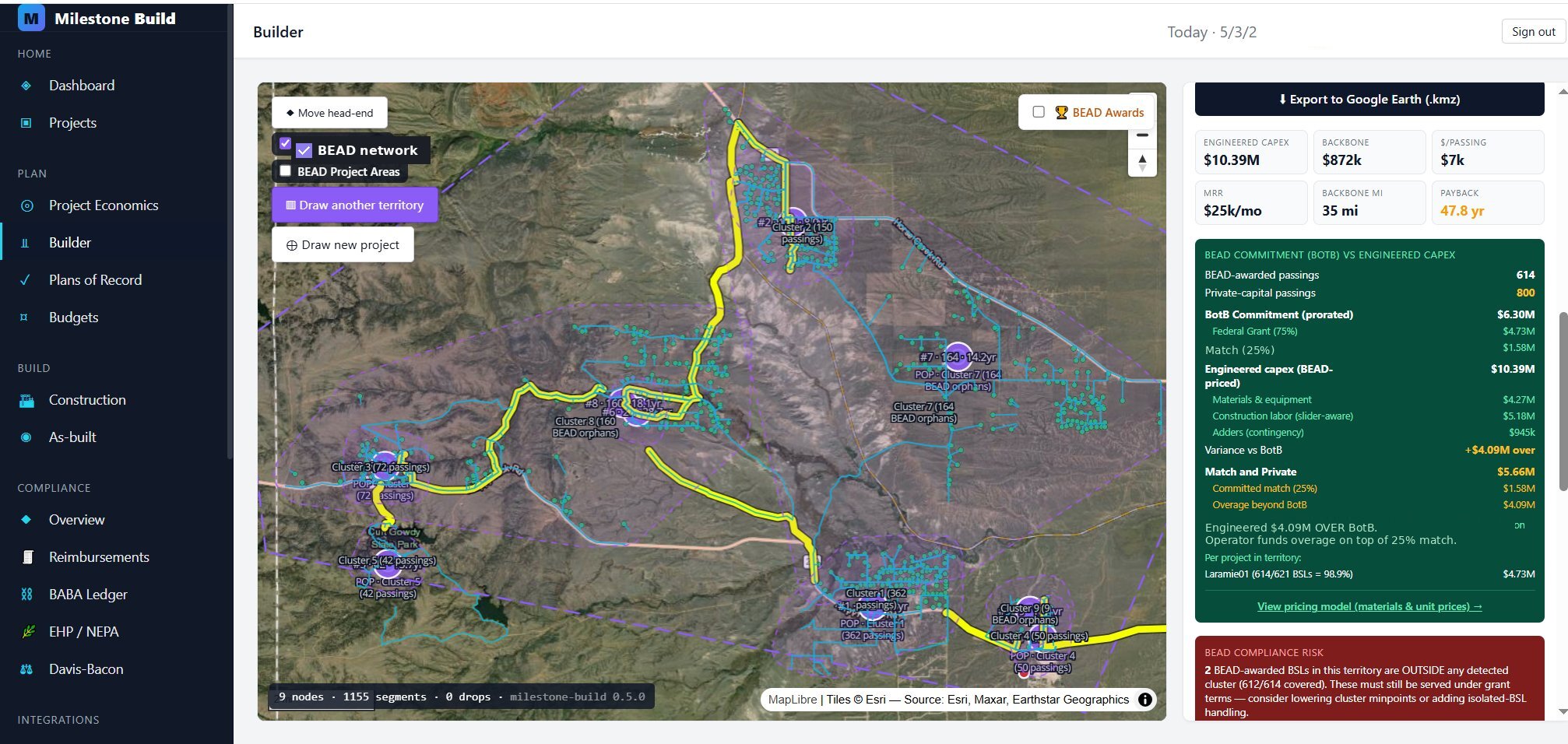
Engineered capex measured against your bid commitment dollar-for-dollar. If you're $4.09M over, the panel says so — and tells you whether it's match-eligible or operator-funded overage.
BEAD-awarded BSLs that fall outside your engineered cluster get flagged. The platform tells you they still need to be served and recommends fixes — minpoint adjustment, isolated-BSL handling, or cluster expansion.
One click. Hand the KMZ to your construction crew, your state portal, or your subrecipient with full route geometry and node placement.
A construction manager moves a phase end date. Build cascades it through every dependent task and every linked compliance obligation — Section 106 consultation, NEPA documentation, SHPO determination, Davis-Bacon payroll cadence — automatically.
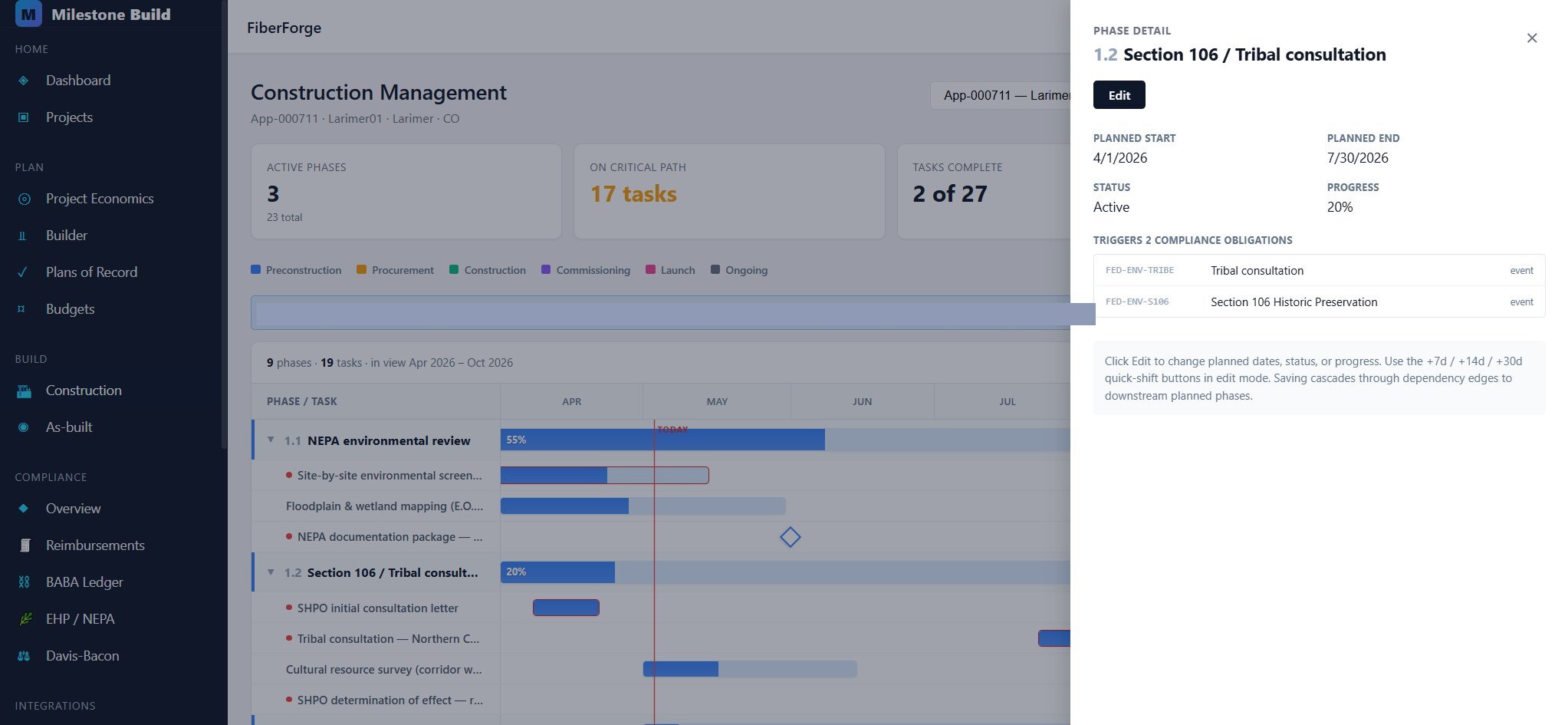
Mainline construction triggers Davis-Bacon. Trenching triggers EHP/NEPA. Each phase carries its compliance consequences forward automatically — no separate compliance calendar to maintain.
17 tasks on critical path, 23 active phases, today's line drawn live. The Gantt your PM already lives in — with federal compliance deadlines layered on top.
Move one date, downstream planned phases shift via dependency edges. Active phases stay put. Compliance obligations re-cadence to the new schedule.
Every federal compliance event for the project, on a calendar, by week, with status. Click any item: source citation, evidence type, owner, cadence, what construction phase triggered it, and the file slot ready for the artifact.
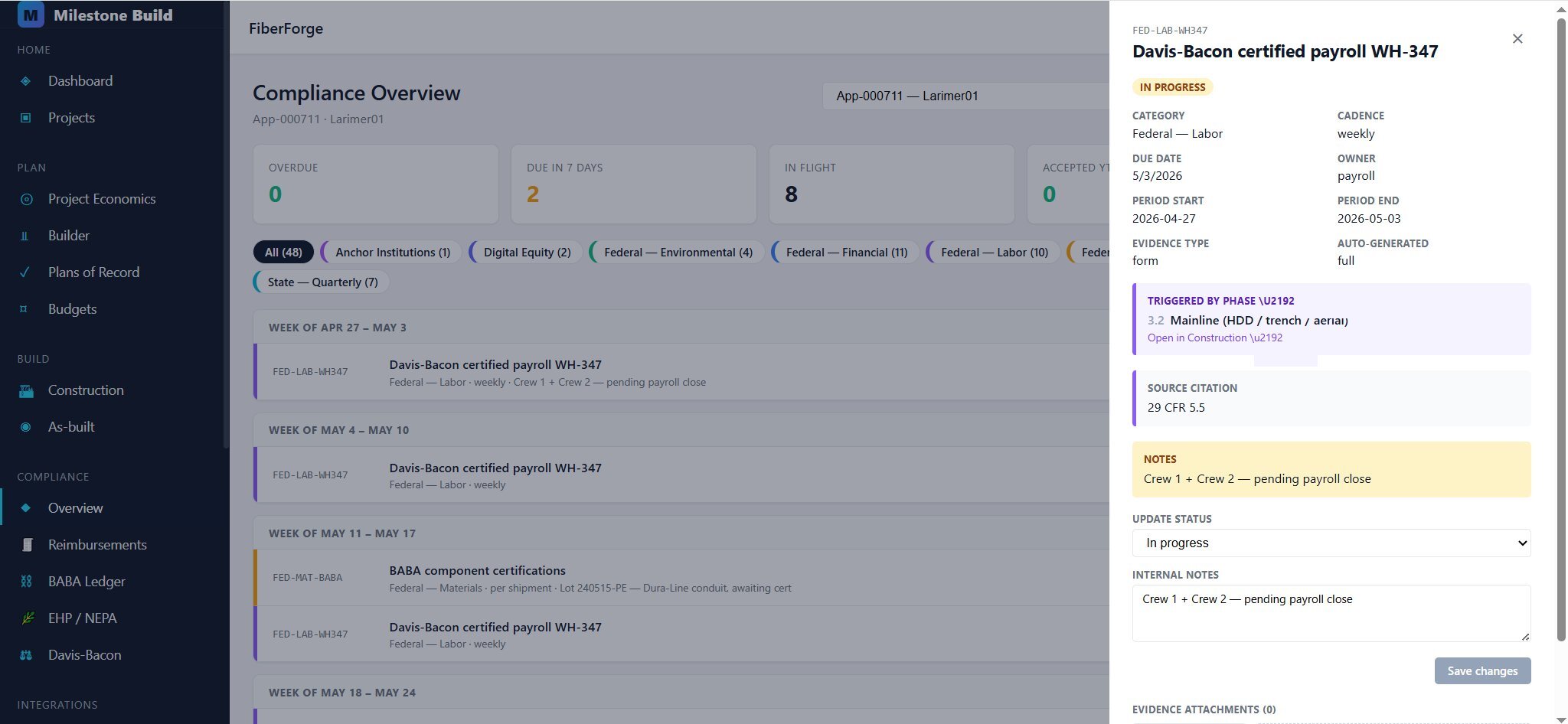
Davis-Bacon payroll WH-347 traces back to 29 CFR 5.5. BABA component cert traces back to its statute. Click any obligation and the regulatory basis is right there.
Federal Labor, Federal Financial, Federal Environmental, Materials, Civil Rights, Cybersecurity, State Quarterly, Anchor Institutions, Climate & Resilience, Digital Equity. The compliance lead’s inbox, organized.
Every upload gets SHA-256, MIME type, and size captured. Every status change writes to the audit log with reviewer, timestamp, and prior state. Nothing gets lost.
Procurement is the single most common BEAD audit failure point. Build's form forces the audit trail to exist by default — the moment you create the event, the platform classifies it under the federal threshold tiers and tells you exactly what artifacts are required.
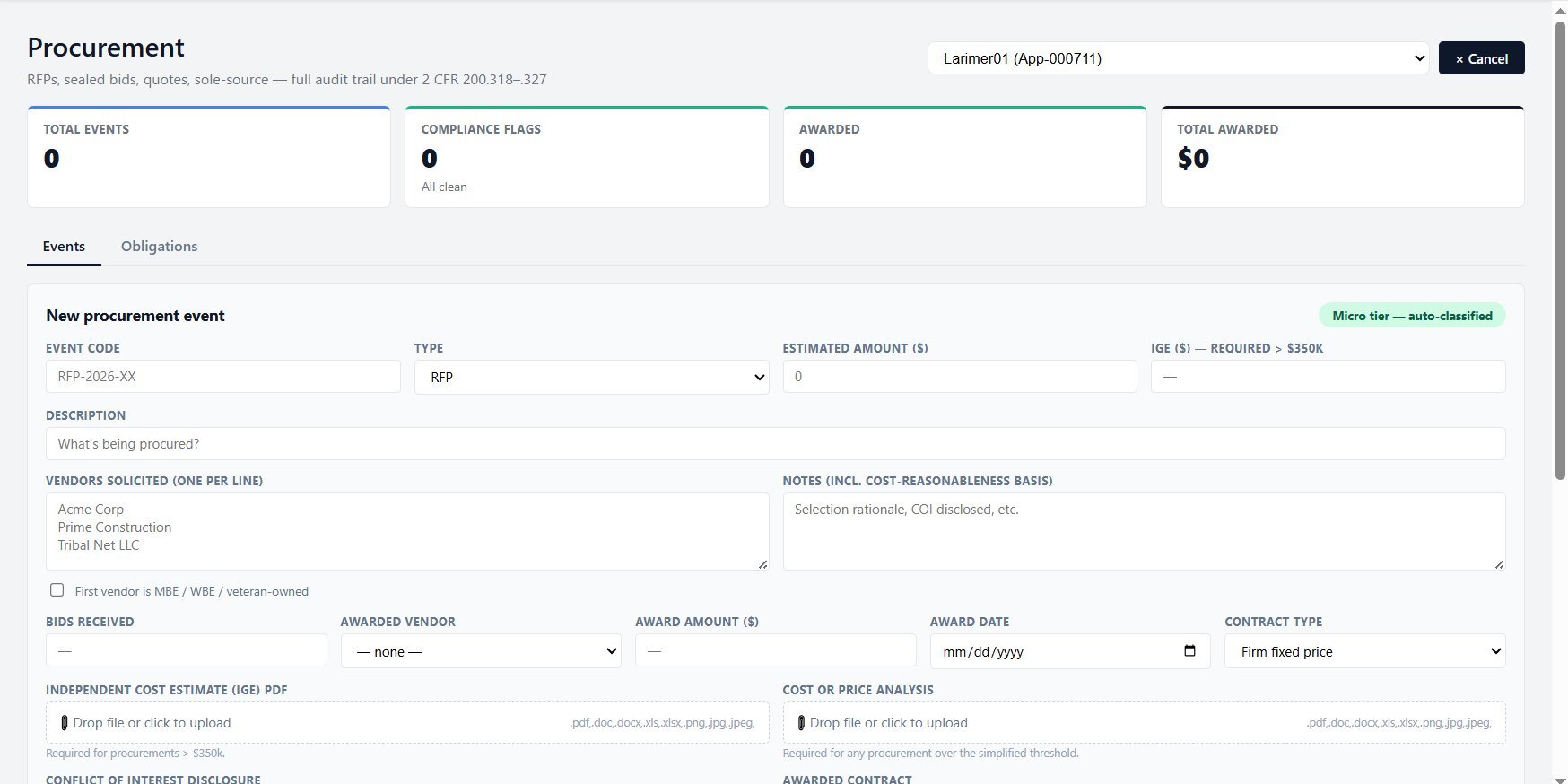
Micro-purchase, simplified acquisition, or sealed bid. Build classifies the event the moment you enter the dollar amount and tells you whether an Independent Government Estimate, cost-or-price analysis, and competition documentation are required.
IGE PDF for procurements over $350K. Cost-or-price analysis for any procurement over the simplified threshold. Conflict of interest disclosure on every event. Missing-artifact red flag if anything is incomplete.
DBE certifications captured per vendor. Set-aside compliance counted at the portfolio level. Federal reporting on socioeconomic spend pulled from the same record.
Per-period actuals, federal claim, match drawn, and category-level variance — all calculated from the procurement events, contracts, and milestone completions already on the platform. Build flags categories under-actuals before submission so you don't get bounced.
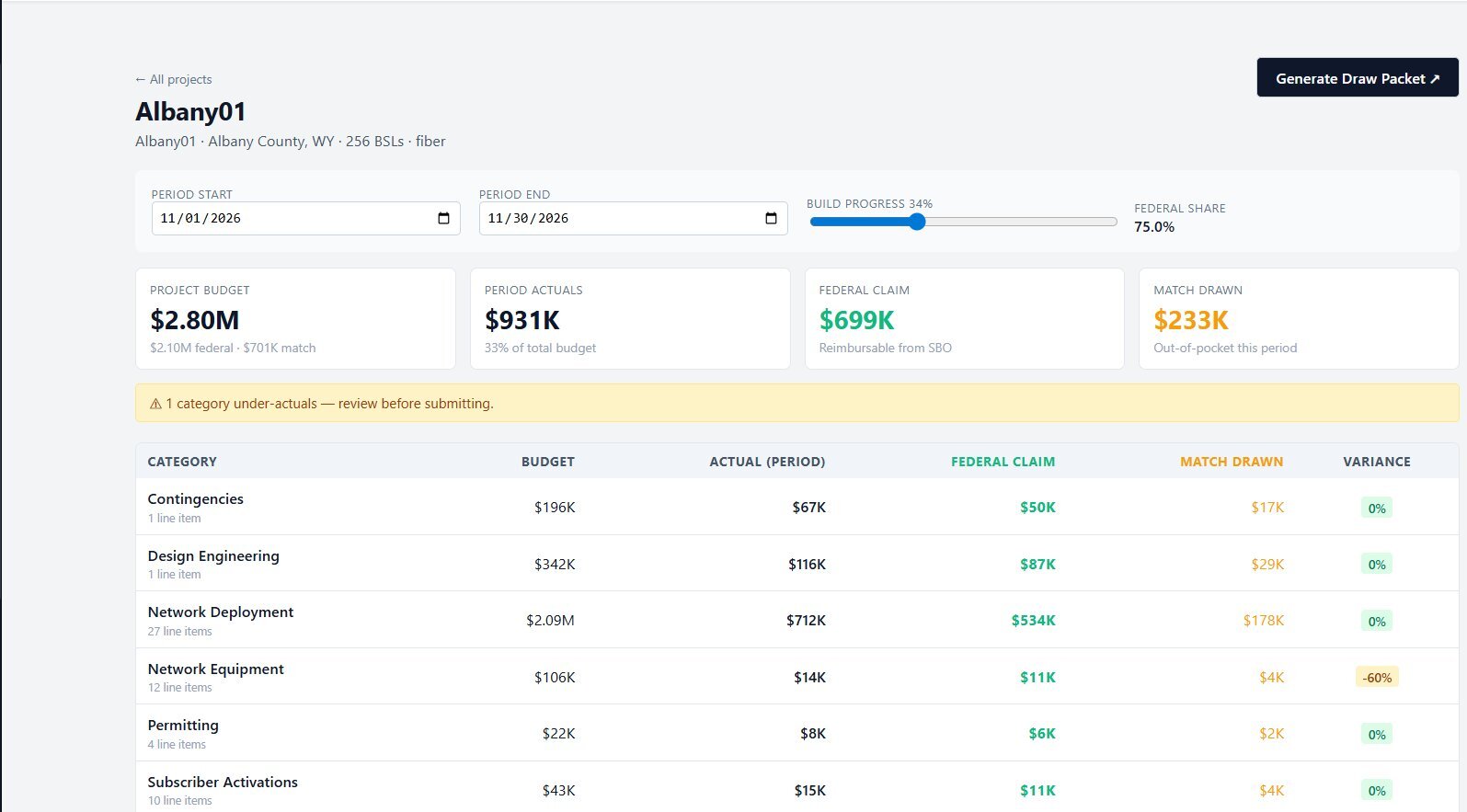
$931K period actuals × 75% federal share = $699K federal claim. Match drawn out-of-pocket separated. SF-425 attachment slots ready.
"1 category under-actuals — review before submitting." A category running 60% under budget gets flagged because state grant administrators will ask. Catch it before they do.
One click. Cover sheet, line-item detail by category, supporting invoices, paid-stamp evidence, and the SF-425 export — ZIP'd and ready for the state portal.
One click generates a structured ZIP archive containing every compliance artifact across your entire project — organized, indexed, and ready for the auditor who shows up on Day 1 of monitoring. No scrambling. No missing attachments.
Every obligation, every cert, every BSL evidence record, every permit crossing, every milestone, every audit log event. CSV and JSON exports plus a human-readable index. The binder that closes the loop on federal compliance risk.
Request a Demo →